

A fence, a repaint, a paver patio: in a deed-restricted community all three go past the architectural committee before they ever reach the building department, and that is the approval that really sets the start date. Florida governs it in chapter 720 of the statutes, and the useful part is how narrow a committee’s authority actually is. It reaches only what the declaration or the published guidelines already say. A denial has to name the rule it relied on. Hurricane protection that meets the board’s own adopted specifications cannot be denied at all. What the chapter does not give anybody is a clock — there is no provision in it that turns silence into approval. Everything below is cited by section, because the only part of a document like this worth having is the part somebody else can check. It is also not legal advice about your community: your declaration governs, and a Florida community-association attorney is who reads it.
The committee’s authority stops at what is published
The first sentence of s. 720.3035(1)(a) is the one to know. Authority to review and approve plans for the location, size, type or appearance of a structure or other improvement, or to enforce standards for external appearance, is permitted only to the extent that the authority is specifically stated or reasonably inferred in the declaration of covenants or other published guidelines and standards authorized by it. The same paragraph adds that those standards must be applied and enforced reasonably and equitably on all parcel owners. So the first two documents in any submittal are the declaration and the published architectural guidelines, downloaded and read, not described over the phone. A preference that appears in neither is not a standard. And s. 720.3035(1)(b)1 puts the inside of the house out of reach entirely where it is not visible from the parcel’s frontage, an adjacent parcel, an adjacent common area or a community golf course — which is the paragraph that covers a bathroom or a kitchen.
If the guidelines offer options, the choice belongs to the owner
Section 720.3035(2) says that where the declaration or the published guidelines provide options for the use of material, the size of the improvement, its design or its location on the parcel, neither the association nor the committee may restrict the owner’s right to select from the options provided. In practice that changes how a packet gets written. Instead of proposing something and waiting to hear whether it is liked, the submittal names the option and the page of the guidelines it came from. An application that picks something already on the published list is a different conversation from one asking for a variance, and most fence, exterior paint and paver work in a Central Florida community is already on the list. The quiet consequence is that a committee that pushes an owner off a published option is acting outside this subsection.
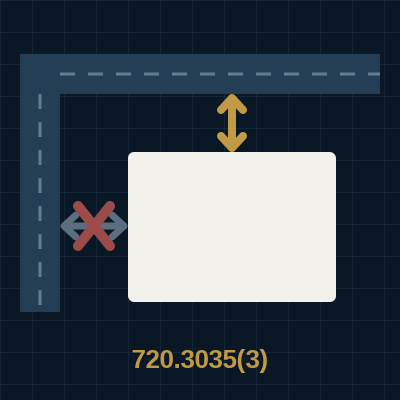
One front, and the city’s setback when the declaration is silent
This is where fence approvals go wrong most often, and it is two rules in one subsection. Under s. 720.3035(3), unless the declaration or published guidelines specifically state otherwise, each parcel is deemed to have only one front for purposes of the required front setback, even if the parcel is bounded by a roadway or other easement on more than one side. A corner lot does not grow a second front setback by itself. And where the declaration provides no specific setback limitation, the applicable county or municipal limitation applies, and neither the association nor the committee may enforce or attempt to enforce a setback that is inconsistent with that governmental standard. A number a committee prefers does not displace the city’s number, and the city’s number is the one the permit will be read against anyway.

The committee meets in the open, and silence is not approval
Section 720.303(2) extends the board’s open-meeting rules to any body vested with the power to approve or disapprove architectural decisions with respect to a specific parcel. Notices have to specifically identify the agenda items and be posted in a conspicuous place in the community at least 48 hours in advance, or, where notice is not posted, mailed or delivered to each member at least 7 days before the meeting — s. 720.303(2)(c)1. So the meeting where a submittal is decided is a meeting the owner may attend, and the agenda has to say it is being decided. What chapter 720 does not contain is a deadline: there is no provision anywhere in it that deems an application approved because nobody answered. Whatever clock exists lives in the declaration, and if the declaration sets none, waiting is not a strategy. Read that before the packet goes in, because every date after it hangs from this one.
A denial has to name the rule, and the specific part that fails it
Section 720.3035(4)(a) requires that when an association or committee denies a request or application to construct a structure or other improvement, it must provide written notice stating with specificity the rule or covenant it relied on and the specific aspect or part of the proposed improvement that does not conform to it. That is the difference between a dead end and a resubmittal, because a denial written that way is a list of what to change. Subsection (4)(b) puts weight on the other side: an association that unreasonably, knowingly and willfully infringes or impairs an owner’s rights under the declaration owes damages caused by it, including costs and reasonable attorney fees. And (5) is the one almost nobody has read — a committee may not enforce a policy or restriction inconsistent with the declaration or published guidelines, whether uniformly applied or not, and may not rely on one in defense of an action taken against an owner. Applying an unpublished rule to everyone equally does not turn it into a rule.
Hurricane protection that meets the specifications cannot be denied
Subsection 720.3035(6) is the newest part of this and the least known. It states that it applies to all homeowners’ associations in the state regardless of when the community was created, and it requires the board or committee to adopt hurricane protection specifications for each structure or improvement on a parcel — which may include the color and style of the products and any other factor the board finds relevant, and all of which must comply with the applicable building code. Then (6)(b): notwithstanding any other provision in the governing documents, an application to install, enhance or replace hurricane protection that conforms to those adopted specifications may not be denied. The board may still require adherence to an existing unified building scheme for external appearance. Paragraph (6)(c) defines hurricane protection broadly, including roof systems recognized by the Florida Building Code which meet ASCE 7-22, permanent fixed storm shutters, roll-down track storm shutters, impact-resistant windows and doors, polycarbonate panels, reinforced garage doors, erosion controls, exterior fixed generators and fuel storage tanks. So the first question on storm work is not whether the association allows it. It is which specifications the board has adopted.
The construction deposit is the owner’s, and the clock is the completion notice
Most communities collect a deposit before construction starts, and s. 720.303(8)(d) is specific about what happens to it. If an association collects a deposit from a member for any reason, including to pay for expenses that may be incurred as a result of construction on the member’s parcel, those funds must be maintained separately and may not be commingled with any other association funds. On completion, the member may request an accounting of the deposited funds and the association must provide it within 7 days after receiving the request. And the association must remit payment of any unused funds within 30 days after receiving notice that the construction project is complete. The part a contractor actually controls is the trigger: those 30 days run from notice that the work is finished, so the completion notice is worth sending in writing and keeping a copy of, the same day the last item closes out.
None of this is advanced and most of it is reading, which is exactly why it gets skipped — the declaration runs forty pages and the committee is three neighbors with a form. A fence, an exterior repaint and a paver patio are the three scopes this process touches most in a Central Florida community, and all three move faster when the packet names the option the guidelines already allow instead of asking to be liked. On our own scopes the association submittal goes in before any material is ordered, and we prepare, file and chase the paperwork; the permit itself is pulled in the name of whoever holds the license for that scope, the owner or the licensed contractor of record. What is not ours is worth saying too: we are not the association and we approve nothing, we do not practice law, we work as general services or as a subcontractor to a licensed GC, and we only take scopes that do not require a license — anything that does goes to a subcontractor licensed for that trade. If somebody tells you the association will never allow it, the question worth asking is which published rule says so.
OFFICIAL SOURCES
START HERE
One form, one business day.
Describe the scope and we answer within one business day. Drawings and photos by email; emergencies by phone, 24/7.
Related service
HOA & Permit Coordination→