
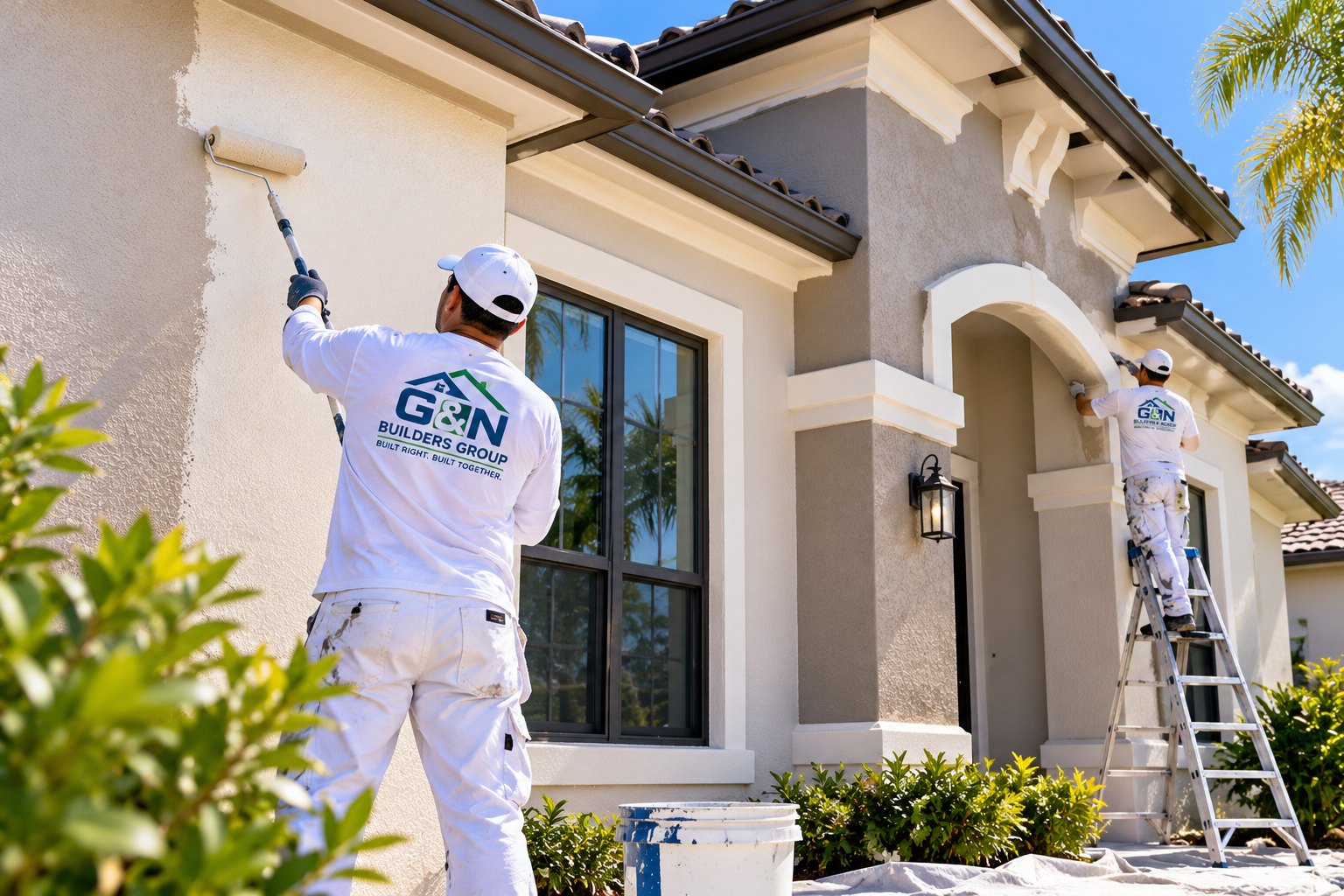
A repaint that peels in two years almost never failed because somebody bought cheap paint. Exterior coatings in Central Florida fail for a short list of reasons, and every one of them is decided before the first gallon is opened: water still moving through the wall, a surface that is chemically hot, chalk left in place, a crack bridged instead of repaired, and a weather window read off a phone instead of off the wall. None of what follows is proprietary — it is the part a coating manufacturer prints on the back of the can and a schedule quietly erases.
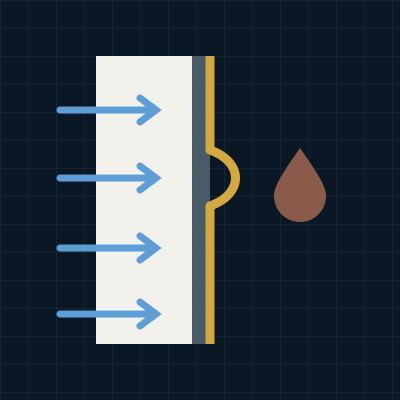
Peeling starts behind the paint, not on it
Stucco absorbs water and gives it back, and the coating over it has to let that vapor out — which is why exterior masonry paints are breathable, and why a film that is not comes off in sheets. In Florida the water is usually getting in somewhere specific: a split sealant joint at a window, a roof edge or flashing that drips down the wall, irrigation heads that hit the stucco twice a day, or soil and mulch piled against the base of the wall. Find that first. Painting a wall that is still feeding itself water is painting a wall that will blister again on the same schedule, and the second repaint fails faster than the first, because now there are two films holding the water in.

Fresh and patched stucco is chemically hot
Portland cement cures alkaline, and free lime keeps migrating to the surface while it does. Paint put over it gets attacked from underneath: the binder breaks down, the color goes blotchy, and a white crystalline bloom — efflorescence — pushes through the film. The conventional wait on new stucco is about 28 days. The shortcut is not to skip that but to use an alkali-resistant masonry primer and sealer, which on our work is Sherwin-Williams Loxon, over bare stucco and over every patch. The step that gets skipped is priming the repairs on their own before the wall is coated: a patch is newer and thirstier than the stucco around it, and if it is only primed along with everything else it reads through the finish later as a shadow in exactly its own shape.
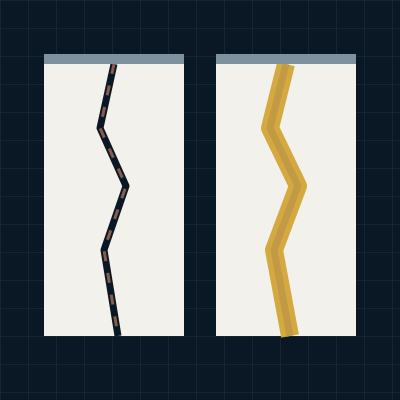
A crack painted over is a crack you will see again
A coat of exterior acrylic is a few thousandths of an inch thick. Bridged across a hairline crack it is a membrane spanning a joint that opens on a hot afternoon and closes on a cool night, and it tears — usually within a season, usually right down the original line. Shrinkage cracking gets opened out, filled with a flexible patching material, textured back so the repair does not read as a smooth stripe through the finish, and primed. A crack that runs diagonally out of a window or door corner, or that keeps returning in the same place, is not a painting problem at all, and coating it just hides it until it is larger.
Chalk is a bond breaker, and Florida makes plenty of it
Ultraviolet light degrades the binder at the surface of an old coating and leaves the pigment behind as a loose powder. On a south or west elevation here that takes a few years, not a few decades. The test is free: rub a dark cloth or your hand across the wall, and if it comes away colored, the wall is chalking. Paint applied over chalk is not bonded to the wall, it is bonded to dust, and it will eventually peel away in sheets with the old color still on the back of them. Pressure washing takes most of it off; whatever is still chalking after the wall has dried needs a masonry conditioner or primer, not a second topcoat.

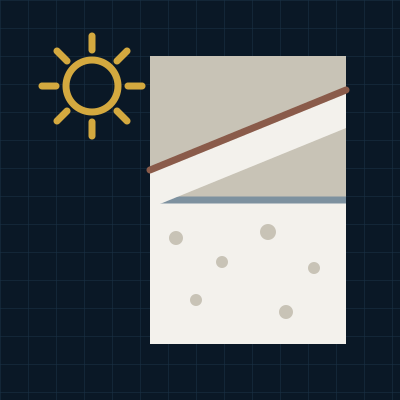
The weather window is part of the specification
What matters is the temperature of the wall, not the temperature of the air, and here the problem is almost always the top of the range rather than the bottom. A wall in direct afternoon sun drives the water out of the film before it has formed properly: it looks right while it is being rolled and shows up later as poor adhesion and blistering. So the work follows the sun around the house instead of fighting it. Humidity stretches the recoat interval well past the number on the label, and the surface has to stay a few degrees above the dew point while the film sets. And the four o’clock storm is a real constraint, not a nuisance — a wall coated at two is not finished at four.

Sealant fails before the coating does, and paint will not save it
The joints around windows and doors, at control joints, and wherever stucco meets a different material are the actual water barrier, and they have a shorter service life than the paint over them. Coating a joint that has gone hard and split does not seal it, it only makes the failure harder to see from the ground. Old sealant gets cut out, the joint faces cleaned, backer rod set so the new sealant is roughly twice as wide as it is deep and bonds to two faces instead of three, and then it is painted along with the wall. One more small discipline belongs on the same list: masking comes off the same day it goes on, because tape left overnight on a fresh film takes the edge of the paint with it.
None of this is exotic, and none of it is visible in a finished wall — which is exactly why two bids on the same house can be far apart and look identical on paper. The paint is the cheapest part of a repaint and the last thing that decides how long it lasts. If a wall is already failing and you want to know which of the six is behind it, the answer is usually in where it is failing: at the bottom of a wall it is water, around an opening it is sealant, in sheets off a sunny elevation it is chalk, and along one straight line it is the crack that was painted over.
← INSIGHTSSTART HERE
One form, one business day.
Describe the scope and we answer within one business day. Drawings and photos by email; emergencies by phone, 24/7.