
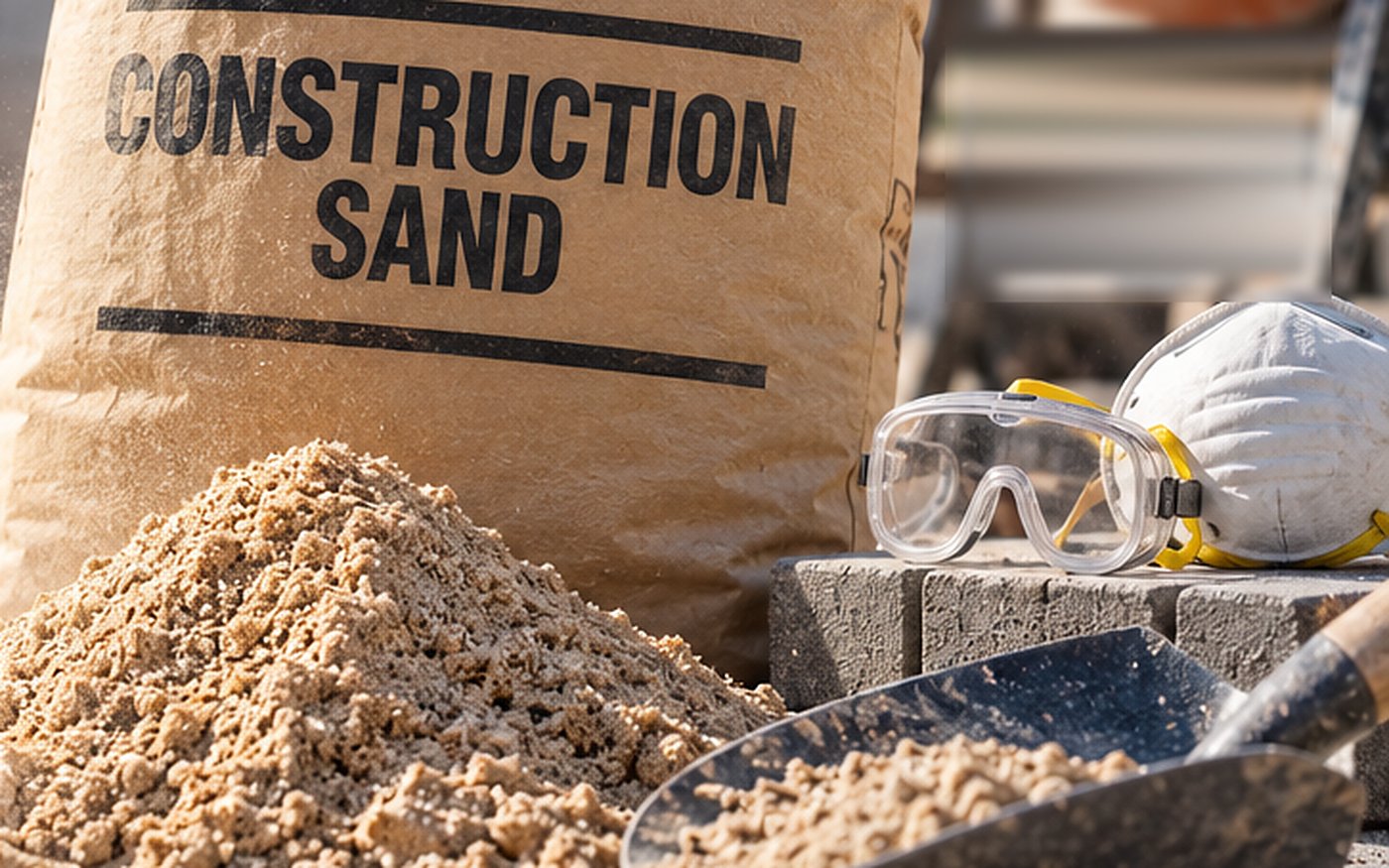
Ask a crew where the silica hazard is and most will point at a saw cutting concrete. That is where the visible dust is. But the health warning is printed on the sack of graded sand itself, in three languages, before anyone has cut anything — because the material arrives with the hazard already in it. Respirable crystalline silica is the particle small enough to reach the deep lung, and OSHA has regulated it in construction under 29 CFR 1926.1153 since 2017. The limit is 50 micrograms per cubic meter of air, averaged over eight hours.
Read the sack before you open it
Sand, mortar, stucco mix and grout are silica-bearing materials, and the bag says so. The warning names silicosis, respiratory disease and an increased risk of cancer, and points at NIOSH and the CDC. It is not decoration and it is not the same on every product — which is why the label is the first thing to read, not the last.

Wet it, or capture it at the tool
Nearly every control the standard specifies comes down to one of two things: water delivered at the point of cut, or a dust collector with a HEPA filter attached to the tool itself. Both work because they stop the particle at the source. Anything done further downstream — a fan, an open door, a mask — is dealing with dust that is already in the air.

Table 1 covers eighteen tasks, and mixing is not one of them
The standard offers a shortcut: follow the specified controls in Table 1 fully and correctly for the task, and you do not have to measure air concentrations or separately prove you met the limit. But Table 1 is a list of eighteen tools and tasks — saws, drills, grinders, jackhammers, milling machines. Emptying dry bags into a mixer is not on it. Step off the table and the obligation changes: you owe an exposure assessment and you have to hold the limit by other means.
No dry sweeping, no compressed air
Cleanup is where a controlled job goes wrong at the end of the day. The standard does not allow dry sweeping or dry brushing where it could add to exposure, unless wet sweeping or HEPA vacuuming genuinely is not feasible. Compressed air to clean clothing or surfaces is out on the same terms, unless it is paired with ventilation that captures the cloud it creates. A broom undoes an afternoon of wet cutting in about a minute.
The respirator is the last layer, not the first
Where Table 1 calls for respiratory protection it is on top of the water or the vacuum, never instead of them. And a respirator only does its job worn, fitted and the right class for the task — hanging under a chin it is exactly as protective as nothing at all.

The plan is a document, and someone owns it
Three things turn this from intention into practice: a written exposure control plan naming the tasks and the controls for each; a competent person designated to make frequent and regular inspections of the site, the materials and the equipment; and medical surveillance made available at no cost to anyone required to wear a respirator thirty or more days in a year, repeated at least every three years, with a chest X-ray and a lung function test.
None of this belongs only to demolition. Sand, mortar and stucco are the ordinary materials of exterior work, slab repair and residential remodeling — the everyday half of what we build. That is the reason it is worth writing down: silicosis has no early symptom to warn anybody, so the exposure never announces itself on the day it happens. The controls have to be in place before there is anything to notice.
← INSIGHTSSTART HERE
One form, one business day.
Describe the scope and we answer within one business day. Drawings and photos by email; emergencies by phone, 24/7.
Related projects
Fence and Gate Installation→