

Since July 1 a licensed Florida contractor has a deadline in statute to pay subcontractors and suppliers. The headline number is 45 days, and it is the easiest part to read wrong: the clock does not start when the work ends, and it does not start when the invoice arrives. It starts when the contractor gets paid for that work.
What the statute actually says
Section 489.1295 of the Florida Statutes — “Prohibition Against Nonpayment” — was created by Senate Bill 290, Chapter 2026-3, and took effect on July 1, 2026. A licensed contractor has to pay a subcontractor or supplier within 45 days after receiving payment for that work or those materials, or on the payment terms of the contract, unless there is a bona fide dispute over the amount due.
The clock runs on the money, not on the invoice
This is where most readings go wrong. Finishing the installation does not start it. Closing a punch list does not start it. Sending an invoice does not start it, and neither does dropping material at the site. What starts the statutory clock is the contractor receiving the payment that covers that work — and the contract’s own payment terms still run alongside it.
It binds licensed contractors, toward subs and suppliers
The obligation runs from a licensed contractor to subcontractors and suppliers, and the same law added both definitions to section 489.105 by pointing at section 558.002. Broadly: a subcontractor puts labor and materials into the work for another contractor, and a supplier provides the materials or equipment. Which one applies depends on how the job is actually structured, not on the word printed at the top of the invoice.
A bona fide dispute has to exist on paper
The exception is real and it is narrow: a genuine disagreement about how much is owed. Work outside the approved scope, quantities that do not match, unapproved substitutions, open punch-list items, damage, extra work with no written authorization, back charges, retainage, missing closeout documents. What does not qualify is a vague complaint raised after the fact. If the reason is not written, dated and specific, it is not documentation — and that cuts both ways.
A violation goes at the license, not just the contract
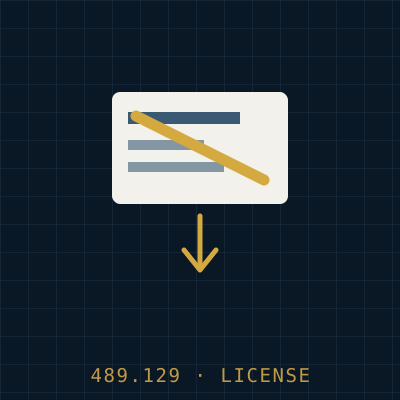
This is the part that changes the stakes. Paying late was already a contract problem. Now a knowing or willful violation is also grounds for disciplinary proceedings under section 489.129 — the section that reaches fines and, at the far end, the license itself. It does not replace suing on the contract; it sits on top of it.
Three clocks, all forty-five days, none the same
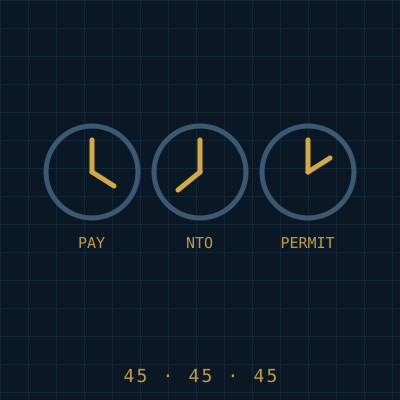
Florida now has three deadlines that all read “45 days” and measure different things. This one is payment, under 489.1295. The second is the Notice to Owner under the Construction Lien Law: a party with no direct contract with the owner generally has to serve it before starting, or no later than 45 days after first furnishing labor or materials. The third came from HB 927 and runs against the local government — 45 days to act on a completed permit application. The payment rule does not pause, extend or replace the lien deadlines.
None of this is new advice. It is ordinary advice that became enforceable: a defined scope, written change orders, dated invoices, and a record of when the upstream payment actually arrived. Those were good practice on June 30 and they are evidence now. On our side it means one thing in particular — when we hold an amount back, the reason goes in writing the day we hold it, not the day somebody asks.
OFFICIAL SOURCES
LEGAL NOTICE
This article is general information, not legal advice, and reading it creates no attorney-client relationship. How Florida law applies depends on the contract, the parties and the facts of each job. For a specific payment dispute, lien deadline or compliance question, consult a Florida-licensed construction attorney.
START HERE
One form, one business day.
Describe the scope and we answer within one business day. Drawings and photos by email; emergencies by phone, 24/7.
Related projects
Preconstruction, Estimating & Project Management→