
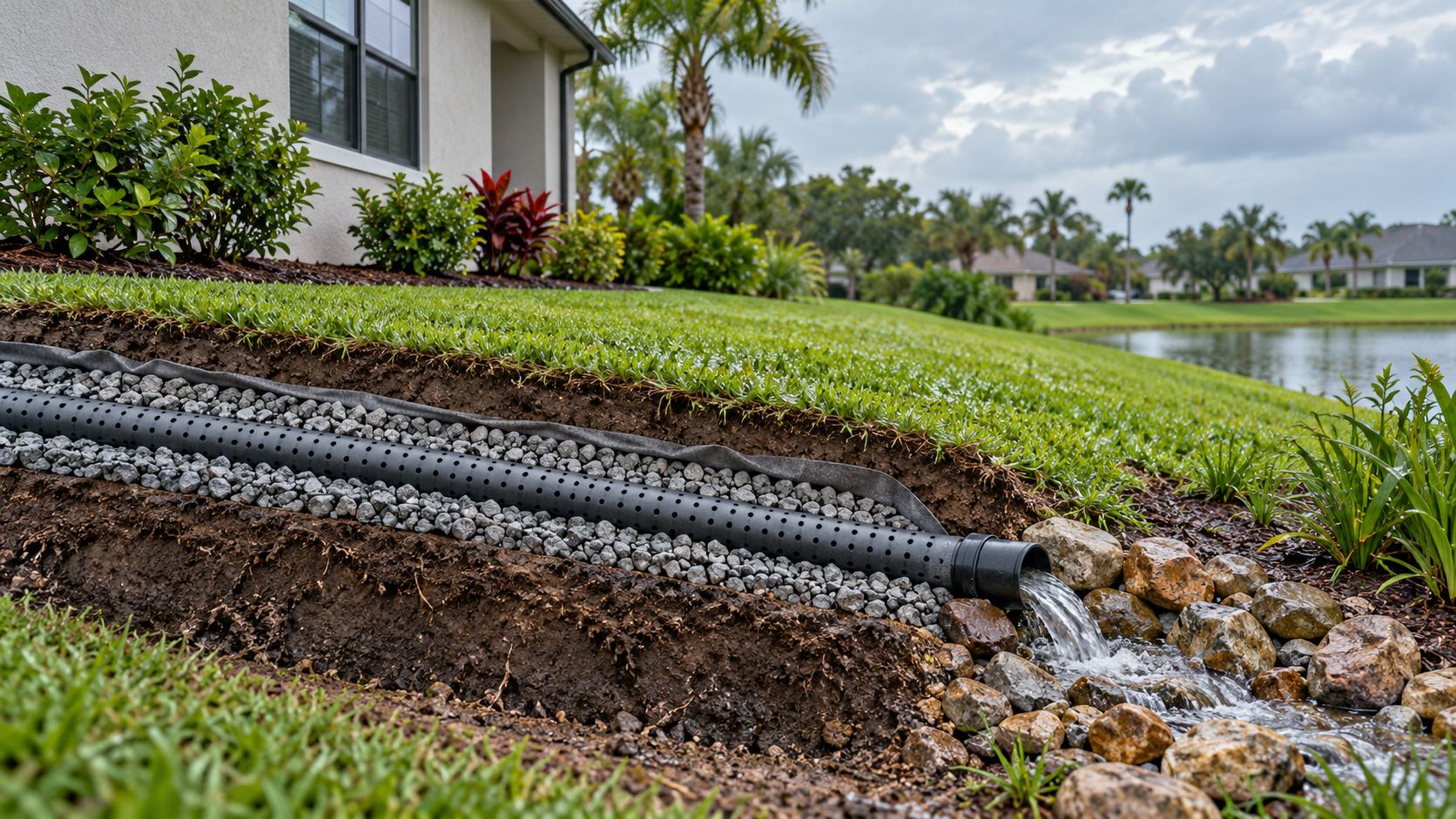
Most of a French drain is a hole, and the hole is the part everybody plans. The stone gets priced, the pipe gets bought, the trench gets dug on the day the crew shows up — and then somebody looks at the far end and asks where the water is supposed to come out. That question had to be answered first, because the answer sets the depth of everything behind it. A drain is not a trench with stone in it. It is a continuous fall from the wet spot to a place the water is allowed to go, and every other decision hangs off that one.
Where the water is allowed to go is decided first
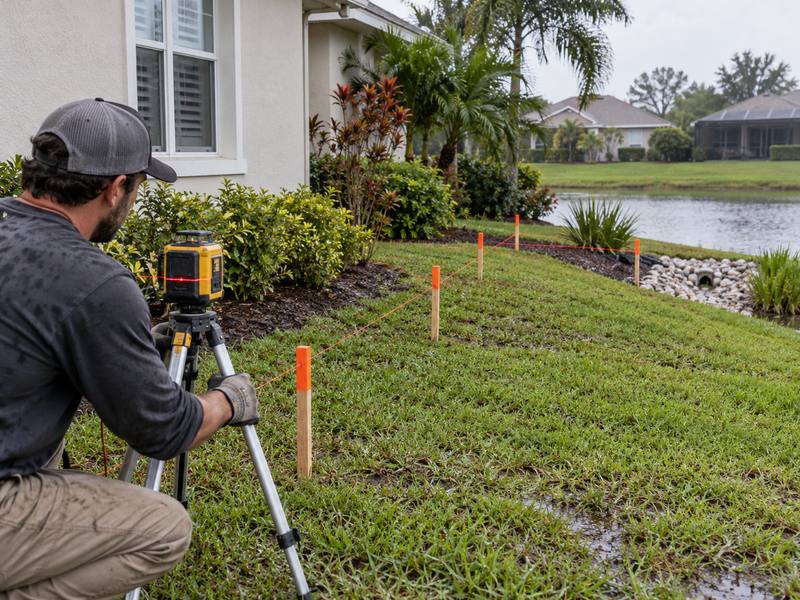
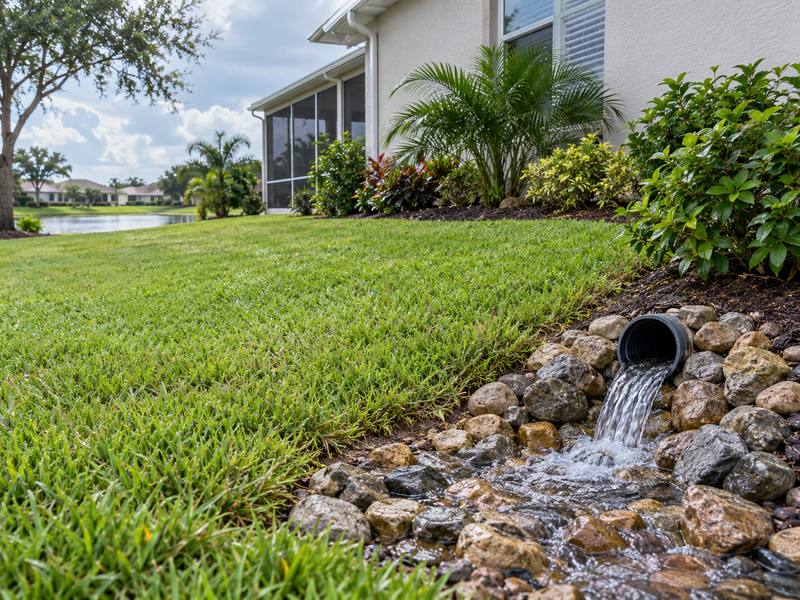
A subsoil drain has to end somewhere specific, and the code is narrow about where. The Plumbing volume of the Florida Building Code puts a subsoil drain outlet at a trapped area drain, a sump, a dry well or an approved location above ground, and sets the minimum at 4 inches in diameter. What it rules out matters more: storm water is not to be drained into sewers intended for sewage only. A yard drain tied into a sanitary line is not a shortcut — it is the thing the code names. The numbering moves between volumes and editions — in the 2023 edition it is 1101.3 and the 1111 series in the Plumbing volume, and P3302.1 in the Residential volume, which is the one that governs a house — so it gets checked against what the county has adopted. Where gravity cannot reach any of those destinations, the design changes shape: a sump and a pump, and a backwater valve where the building is subject to backwater. Those are different jobs at different cost, and knowing which one you have is first-day information, not a discovery at the far end of the trench.
On a flat lot, fall is the scarce material
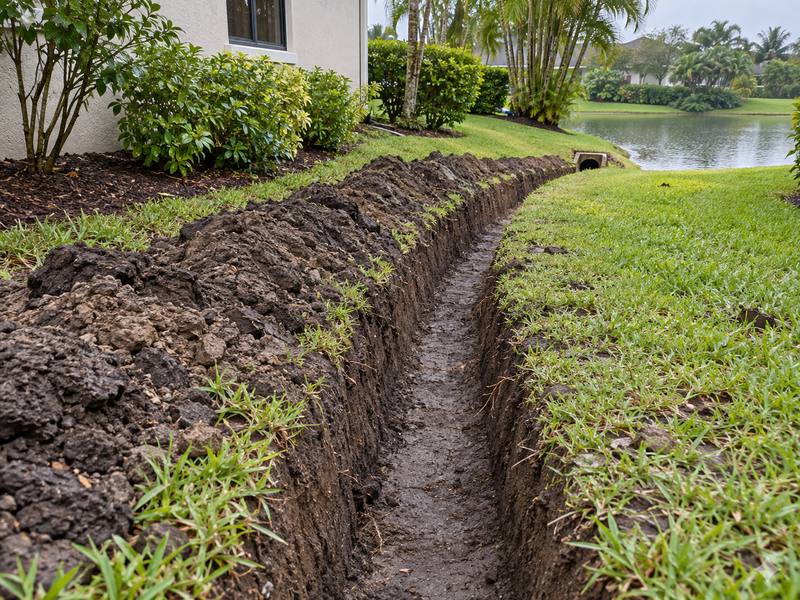
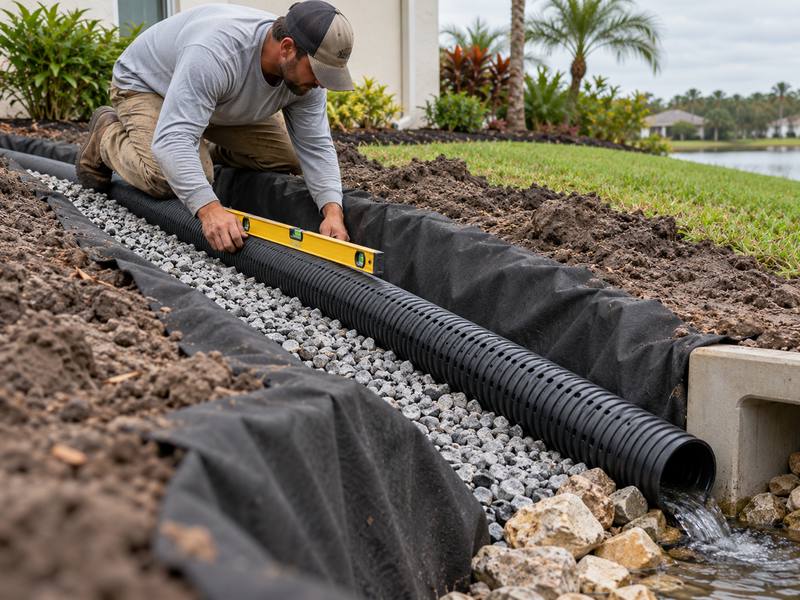
A French drain runs on gravity and on nothing else, so the elevation of the outlet sets the elevation of everything upstream of it. The working target is about 1 percent — an inch of drop for every 8 feet of run, or 1/8 inch per foot — with roughly half a percent as the floor, below which water stands and silt settles out instead of moving. That figure is a rule of the trade and not a code minimum for a yard drain, which is worth saying plainly because it gets quoted as though it were law. The useful part is the sequence it forces: shoot the outlet first, then work backwards to the wet spot and see how deep the head of the trench has to be. On a Central Florida lot with 14 inches of fall across 120 feet, that arithmetic is the whole design, and it goes better with a laser on the first morning than with a shovel on the third. And before anything opens: a drain trench is a long line where a fence is a row of points, so it crosses more buried things. The same two-full-business-day Sunshine 811 notice applies, and what it will not mark is everything downstream of the meter.
A drain below the water table fills from below
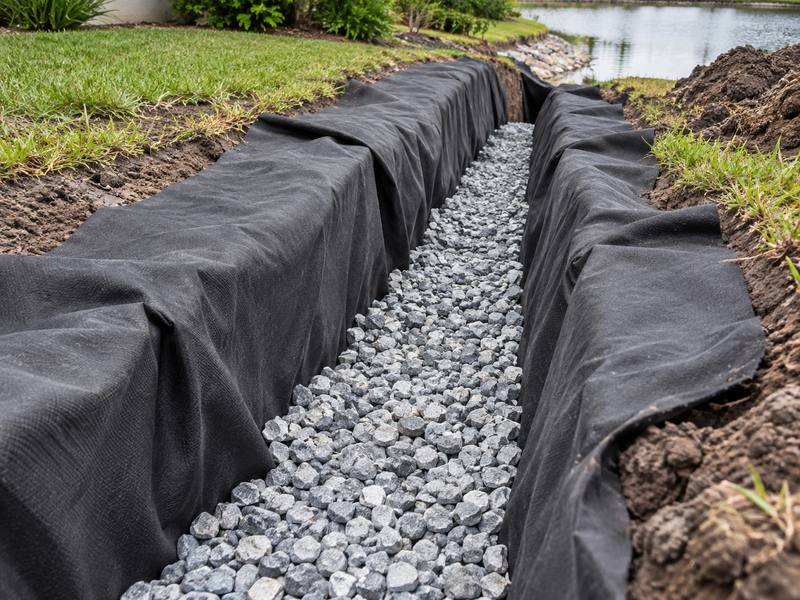
Florida’s constraint is not rainfall. It is how little room there is under the grass. The seasonal high water table is defined as the highest average depth to a zone of saturation — the level that normally holds for several weeks or more in the rainiest part of the year, not the level you find on a dry morning in March. A trench bedded below it does not collect surface water, because it is already full of groundwater, and the first thing the owner reports is a drain that runs in the dry season and stands in August. Where that level sits is read from soil borings or from the USDA NRCS soil survey for the parcel, not from the hole that was dug to look. One dry-season observation is the cheapest way to be confidently wrong about a wet-season problem.
Washed stone is a specification, not an adjective
The stone is what stores and moves the water, and it only does that if the voids between the pieces stay open. That is why the drainage default is an open-graded, angular, washed stone in the No. 57 gradation: in round numbers, everything passes the 1-1/2 inch sieve, 95 to 100 percent passes the 1 inch, 25 to 60 percent passes the 1/2 inch, and only 0 to 10 percent gets through the No. 4. That last band is the entire point. The fines are what fill the voids, and a load of unwashed pit stone can look perfectly like gravel and still be mostly dead volume once it is wet. Angular matters too: crushed faces lock against each other and leave void space, where rounded river stone packs tighter.
The fabric is a filter, and it is chosen against the soil
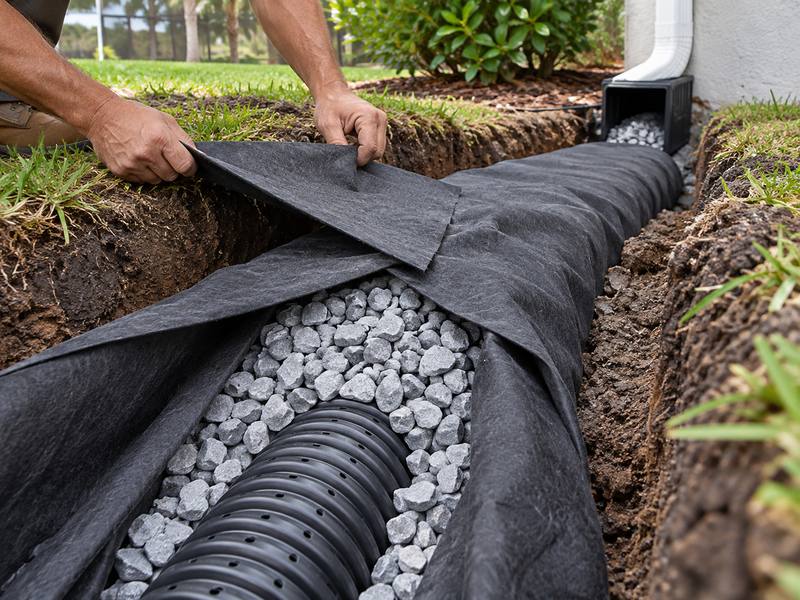
The geotextile is not a wrapper to keep the stone tidy. Its job is to pass water while holding the surrounding soil out of the voids, which means the fabric has to suit the soil it is working against. AASHTO M288 treats subsurface drainage as a Class 2 survivability application and sets the hydraulic requirements — apparent opening size and permittivity — by how much of the in-situ soil passes the No. 200 sieve. The exact figures have moved between editions and between agency specifications, so they get confirmed against the adopted spec rather than copied off a supplier’s page. What does not change is the shape of the decision: nonwoven, needle-punched, and selected for the fines content on that lot. And the fabric lines the trench against the soil — the code allows either wrapping the pipe or covering the washed stone over the drain. A sock on the pipe alone is a far smaller filter area doing the same work, which is why it is the part that plugs first in fine soil.
Perforations down, bedded and covered, tested before it is buried
The pipe is the last thing to decide and the first thing people argue about. Perforations face down: water rises into the pipe through the stone bed, so holes on the bottom collect from the saturated zone and let the pipe empty itself between storms, while holes on top wait for water to arrive from above and leave standing water in the barrel. The bedding is published, in the foundation drainage section of the Residential code — written for a foundation that encloses usable space below grade, which in Florida is almost never the job, but it is where the code puts numbers on a gravel-and-pipe drain: pipe on not less than 2 inches of washed gravel or crushed rock, covered with not less than 6 inches of the same material. Then the test, which costs ten minutes and gets skipped constantly: run a hose into the head of the open trench and watch the outlet. Water arriving at the far end before the trench fills is the only proof the fall is real. After backfill the same test proves nothing, and the trench is no longer somewhere you can look.
None of this is exotic, and that is the uncomfortable part. A French drain that fails almost never fails because somebody could not dig. It fails because the outlet was decided last, or the fall was assumed instead of shot, or the stone arrived with fines in it, or the fabric was whatever was already on the truck. Every one of those is a decision made before the first shovel, by somebody standing in the yard with a level and a soil survey. The trench is a day of work. The drain is what was decided the week before.
← INSIGHTSSTART HERE
One form, one business day.
Describe the scope and we answer within one business day. Drawings and photos by email; emergencies by phone, 24/7.