
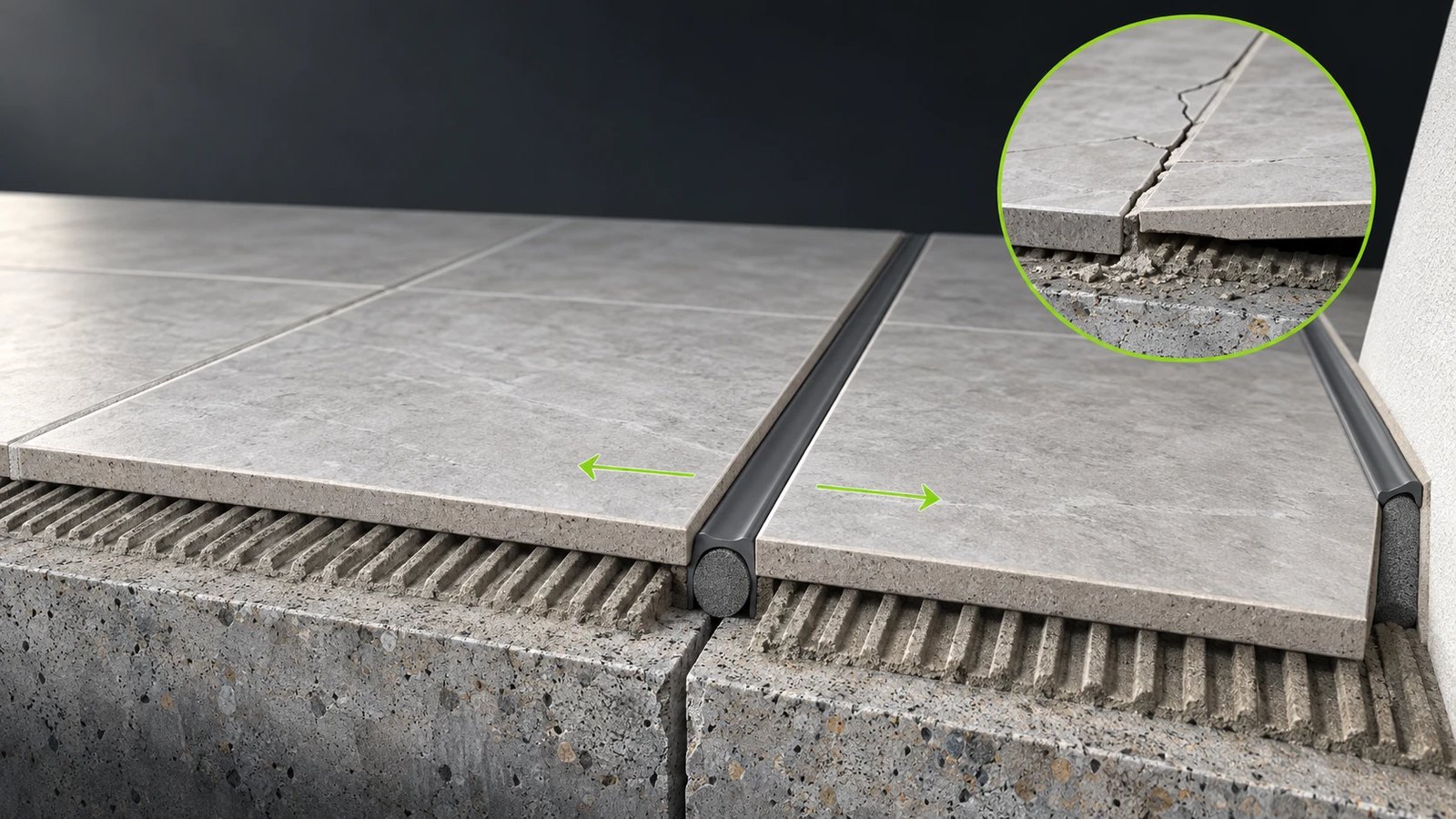
A cracked porcelain floor almost never means somebody bought bad tile. Ceramic and porcelain are extremely strong in compression and brittle in bending, so a tile assembly does not absorb movement — it transmits it until something lets go, and what lets go is the grout joint, the bond, or the tile itself. Everything below is ordinary published practice: the deflection limits in the ANSI A108 series, the movement joint spacing in TCNA EJ171, the crack isolation membranes covered by ANSI A118.12, and the mortar coverage required by ANSI A108.02. None of it is a trade secret. It is just the part of a tile installation that is finished and buried before anybody sees the floor.
The crack usually starts under the tile
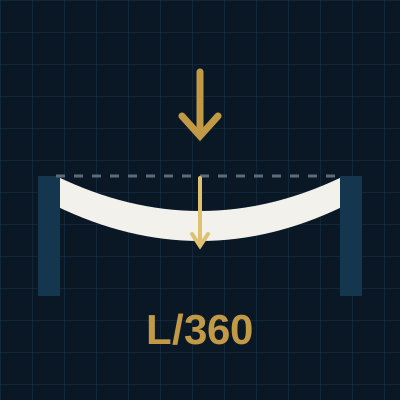
A bonded ceramic or porcelain floor needs the structure beneath it to be stiff, not merely strong. The working limit is L/360 of the span under total load for ceramic and porcelain, and L/720 for natural stone — that is deflection, not capacity, and a floor can pass a load check and still fail that number. Bouncing joists, an undersized subfloor, or a span that was fine for vinyl and is not fine for tile all end in the same place. Measuring it before anything gets bonded costs an afternoon; discovering it afterwards costs the floor.

Movement joints are in the standard, not a preference
TCNA EJ171 puts soft joints on a grid through the field of tile: roughly every 20 to 25 feet in each direction indoors, and every 8 to 12 feet outdoors or anywhere indoors that gets direct sunlight or standing moisture. In Florida that second number is the one that matters more often than the first — a tiled lanai, a pool deck or a patio in full sun is in the tight spacing, not the loose one. A tile field big enough to need a joint and built without one is a field that has already decided where it will crack.
The perimeter joint is the one that gets skipped
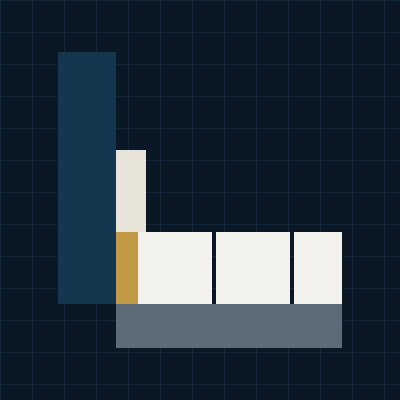
Wherever the tile meets something that restrains it — a wall, a column, a curb, a threshold, a cabinet toe kick — the field needs a soft joint filled with sealant, not grout. It ends up hidden behind the base or the baseboard, so nobody sees it and it is the easiest line to leave out. Grouting hard to the wall is the single most common reason a floor tents: the tile expands, has nowhere to go, and lifts off the substrate in a ridge.
A joint in the slab has to come up through the tile
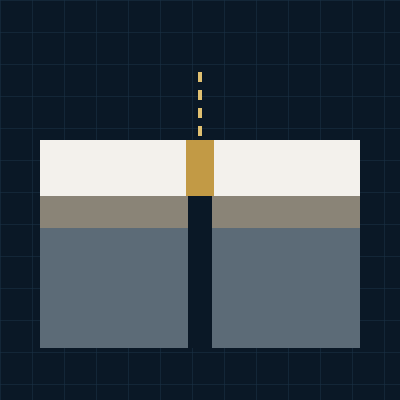
Concrete slabs are poured with control joints and sometimes expansion joints, and those joints are still working after the tile goes down. They have to be carried up through the setting bed and the tile in the same place and at the same width. Bridging one with mortar and grout does not close it — it just decides that the next movement will be relieved by breaking the tile instead of opening the joint. This is the one place where being neat and being correct point in opposite directions.
An anti-fracture membrane is not a movement joint
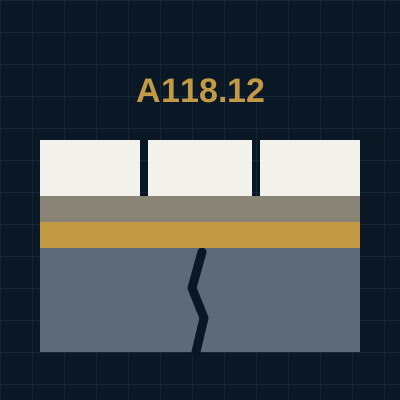
A crack isolation membrane tested to ANSI A118.12 does a specific job: it uncouples the tile from in-plane shrinkage cracking in the substrate, up to about 1/8 inch. That is genuinely useful over a slab that has hairline cracking, and it is the right product in that case. It does not handle vertical differential movement, it does not span a structural joint, and it does not buy permission to leave out the EJ171 joints. A membrane installed instead of joints is a more expensive floor that fails the same way.
Coverage is what the tile survives on
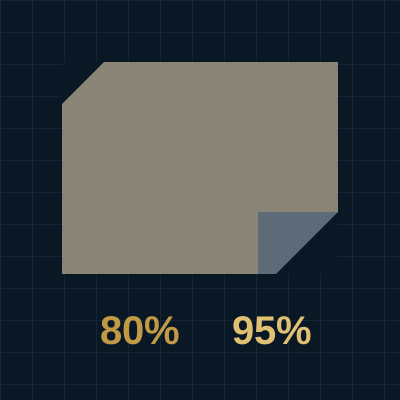
ANSI A108.02 asks for at least 80 percent mortar coverage on dry interior floors and 95 percent in wet areas and on exteriors, with full support under every corner and edge. The number matters because a void under a corner turns a distributed load into a point load, and that is where the crack starts. Large format tile gets back-buttered for the same reason, and the substrate gets flattened to 1/8 inch in 10 feet first, because a mortar bed is a bonding layer and not a levelling compound.
This is the unglamorous half of tile work: deflection measured before anything is bonded, joints laid out before the first sheet is cut, membranes chosen for the condition they actually treat, and coverage checked by pulling a tile back up while the mortar is still open. It is also why a tile floor that was installed correctly is boring — it just stays flat. If you have a cracked floor and want to know which of the six is behind it, the answer is usually visible in where the crack runs, not in the tile itself.
← INSIGHTSSTART HERE
One form, one business day.
Describe the scope and we answer within one business day. Drawings and photos by email; emergencies by phone, 24/7.
Related projects
Residential Renovations & Property Improvements→